
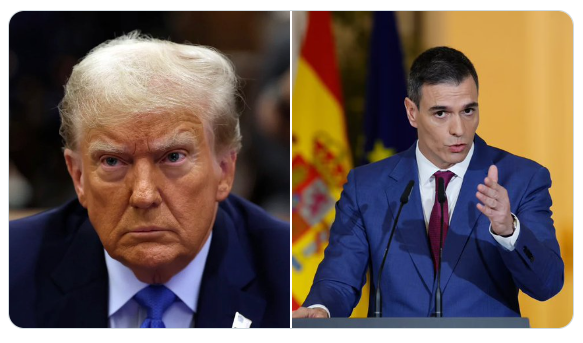

In a stunning escalation of international tensions, U.S. President Donald Trump announced that the United States would end all trade with Spain, sending shockwaves through diplomatic and financial circles. The declaration, delivered during a press briefing, marks one of the most aggressive trade statements directed at a European ally in recent history.
The president framed the decision as a response to what he described as Spain’s failure to meet certain defense and strategic commitments, particularly within NATO frameworks. His remarks immediately raised questions about whether the move represents political rhetoric or a formal economic policy shift.
⚖️ Legal and Economic Reality Behind the Statement
Despite the forceful language, completely halting trade between two allied economies is legally complex. U.S.–Spain trade operates within broader agreements negotiated through the European Union, meaning Washington cannot isolate Spain without affecting EU-wide trade relations.
Additionally, global commerce rules overseen by the World Trade Organization limit the ability of member nations to impose blanket trade bans without formal justification or structured tariff procedures.
While tariffs can be increased under U.S. trade law, a total suspension of imports and exports would likely require emergency executive measures, congressional involvement, or national security declarations.
🇪🇸 Spain Responds to the Escalation
Spanish leadership responded swiftly. Prime Minister Pedro Sánchez emphasized that Spain remains committed to its international alliances and defended the country’s economic and defense policies.
Madrid signaled that any unilateral U.S. action targeting Spain would be addressed collectively through the European Union. Spanish officials also reiterated that defense spending debates should remain within the framework of NATO, rather than being leveraged through trade retaliation.
📊 What’s at Stake Economically
The United States and Spain maintain billions of dollars in annual trade across sectors including:
• Automotive manufacturing
• Agricultural exports such as olive oil and wine
• Pharmaceuticals
• Energy infrastructure
• Tourism and aviation
A full disruption would affect supply chains on both sides of the Atlantic. American importers rely heavily on Spanish agricultural goods, while Spanish industries depend on U.S. technology and machinery exports.
Financial markets reacted cautiously following the announcement, with analysts noting that abrupt trade disengagement could ripple across European and American business sectors.
🌍 Broader Implications for U.S.–EU Relations
The situation extends beyond Spain alone. Since Spain negotiates trade policy through the European Union, any sustained trade confrontation could escalate into a broader U.S.–EU dispute. That would dramatically raise the stakes, potentially triggering retaliatory tariffs or countermeasures from Brussels.
Diplomatic observers suggest the statement may be a negotiating tactic aimed at increasing pressure over defense spending obligations rather than an immediate economic cutoff. However, the language used was unusually direct, increasing uncertainty among multinational corporations.
🔎 Final Assessment
President Trump’s declaration has intensified already strained economic and diplomatic dynamics between Washington and Madrid. Whether this becomes a symbolic warning or a legally enforceable policy will depend on formal executive actions in the coming weeks.
For now, global markets and policymakers are watching closely, aware that even the threat of trade termination between allied economies can reshape investment decisions and geopolitical strategy.